
Ladson has long humid summers and afternoon thunderstorms, so air conditioners run for months and pull a surprising amount of water out of the indoor air. When the drain that carries that water away clogs, it shows up as a ceiling stain, a drip at a vent or a damp closet floor.
Key takeaways
- An air conditioner removes water from indoor air all summer, and a clogged drain sends that water into ceilings, closets and attic insulation.
- A ceiling stain that grows during dry weather points to the air handler, not the roof.
- Turning the system off at the thermostat stops new water from forming while the drain is checked.
- Wet insulation above a ceiling keeps holding water after the stain stops spreading.
- The source is stopped first, then the ceiling is opened and dried.
How an AC drain overflow starts
As warm air crosses the cold coil of an air handler, water condenses and drips into a pan. A drain pipe carries it outside or to a plumbing connection.
Over a humid summer, algae and sludge build up inside that pipe. When it clogs, the pan fills and spills, or the water backs up and leaks at a joint.
A typical system moves large volumes of air, so on a humid afternoon the pan can fill faster than expected.
- A float switch is meant to shut the system off when the pan fills, but a failed or missing switch lets the pan keep filling.
- Metal drain pans under attic units can rust through and leak straight into the ceiling.
- A drain hose that sags or slips off its fitting dumps water inside the cabinet or closet.
- A frozen coil can melt all at once and overwhelm a drain that normally copes.
Where the air handler sits changes the damage
The same clog does different harm depending on where the unit is installed.
Attic units
An attic air handler leaks into insulation first and the ceiling second. By the time a stain shows, the insulation above it may already be soaked.
The ceiling drywall then sags under the weight of the water.
- Look for a stain near the attic access or under the unit.
- Brown rings with darker edges show repeated wetting.
Closet and garage units
A unit in a hall closet or garage drips onto the floor and into the wall bottoms. Water can move under flooring before anyone notices.
Swollen baseboards, a musty smell or a soft spot in the flooring near the closet are common signs.
- Check the floor around the unit with a dry towel.
- Look for rust or water marks on the bottom of the cabinet.
Signs that point to the AC and not the roof
Roof leaks follow rain. AC drain leaks follow cooling, so a stain that grows on hot, dry days usually belongs to the drain.
Afternoon thunderstorms can muddy the picture, so comparing the stain with the weather and with the air conditioner run time helps.
- The stain grows on dry days while the system is running.
- The stain sits near the air handler or a duct run.
- The secondary pan or the drain opening holds standing water.
- The ceiling feels cool or damp, not just stained.
- A musty smell shows up in a closet or hallway.
Safe first steps
Switch the system off at the thermostat so no new water forms. If water drips near a light fixture, turn off the power to that area at the panel.
Keep clear of a ceiling that bulges or sags, because wet drywall can drop without warning.
The thermostat is the fastest control. Turning the system off also protects the air handler from running with a blocked drain.
- Move furniture and rugs away from the wet area.
- Set a bucket under any steady drip.
- Photograph the stain, the air handler and the pan before anything changes.
- Leave the system off until the drain is cleared.
How the wet cavity is dried
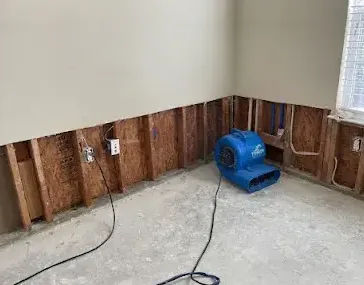
Once the drain is cleared, the crew checks the attic or closet with moisture meters to see how far the water traveled. Standing water is removed, and wet insulation comes out because it keeps holding moisture.
Insulation is the main reason these jobs run longer than the stain suggests. Fiberglass batts hold water against the drywall, and loose insulation can clump and stay wet.
Where the drywall has sagged, a section is cut out so the joist bays can dry. AC condensate and drain leak cleanup often ends with ceiling leak water damage repairs after the framing reads dry.
Fans and a dehumidifier then run under structural drying monitoring, because damp insulation and framing can grow mold within a couple of days.
- Moisture meters map the wet area.
- Wet insulation is removed and replaced.
- A section of ceiling is opened to reach the joist bays.
- Readings are repeated until the framing is dry.
Keeping the drain clear through the humid season
A heating and cooling technician can flush the drain and test the float switch before the heaviest cooling months. A scheduled rinse of the drain also slows buildup.
After a leak, the drying time estimator helps set expectations for how long the wet area needs.
- Test the float switch once a season.
- Check the pan for standing water when the weather turns humid.
- Replace a rusted pan before it leaks.
- Know where the thermostat and the panel switch are.
When the leak has run for weeks
A slow drain leak can run for weeks before a stain appears. The insulation, the ceiling drywall and the wood framing absorb water in turn, and the stain is the last sign.
Long exposure is why a ceiling that looks only mildly stained can need a larger section opened. Moisture readings decide the size of the opening, not the size of the stain.
- Stains with several rings suggest repeated wetting.
- Musty air in a room points to damp materials above.
- Paint that bubbles or peels near the ceiling edge shows trapped moisture.
- Sagging near a vent or light fixture signals that the drywall is holding water.
Questions
How can a homeowner tell an AC leak from a roof leak?
Roof leaks follow rain, while AC drain leaks follow cooling. A stain that grows on a hot, dry day, or one close to the air handler, points to the drain.
Is it safe to keep the air conditioner running with a drain problem?
No. Running it keeps producing water that has nowhere to go. Turn it off at the thermostat until the drain is cleared.
Does a small ceiling stain mean a small problem?
Not always. Water often soaks the insulation above the ceiling and travels along joists before a stain shows. The stain marks where it got through, not how far it spread.
Who fixes the drain and who dries the ceiling?
An air conditioning technician clears the drain and repairs the unit. The restoration crew removes the water, opens the ceiling where needed and dries the framing.
Should a bulging ceiling be cut open to let the water drain?
Only when the sag is severe and a professional advises it, because a wet ceiling can fall. A restoration crew can open it in a controlled way and dry the cavity behind it.
Do attic air handlers leak more often than closet units?
Neither type is immune. An attic leak soaks insulation and the ceiling below, while a closet leak reaches floors and wall bottoms. Where the unit sits decides which materials get wet.