About 3,012 Goose Creek housing units are in buildings of five or more units, according to the American Community Survey 2024 5-year estimate. In those buildings, a leak in one unit does not always stay in that unit.
Key takeaways
- About 3,012 Goose Creek housing units sit in buildings of five or more units, and about 833 in buildings of 50 or more.
- About 31.8% of occupied Goose Creek homes are renter occupied, 5,656 of 17,780 occupied units.
- A washer, dishwasher or toilet leak upstairs can soak the ceiling and walls of the unit below.
- Tell the property manager right away, in writing, and photograph the damage in both units.
- A sagging ceiling is unsafe, and both units may need extraction and drying.
Why multi-unit buildings are different
The American Community Survey 2024 5-year estimate puts about 3,012 Goose Creek housing units in buildings of five or more units. About 833 units are in buildings with 50 or more units.
In a stacked building, water follows the easiest path: down through floor joists, along pipe chases and into the ceiling cavity below. A small spill upstairs can become a damp ceiling downstairs.
About 12,622 Goose Creek housing units are detached single-family homes, and about 1,738 are attached single-unit homes such as townhomes. Attached homes share walls, so a leak can cross a party wall as well as a floor.
Where upstairs leaks come from
Most upstairs leaks begin with a fixture or an appliance that uses water every day.
- A washing machine hose that cracks or slips.
- A dishwasher supply fitting or drain hose.
- A toilet supply or a tub that overflows.
- A water heater that leaks into a closet.
- An ice maker hose behind a refrigerator.
What the downstairs resident sees first
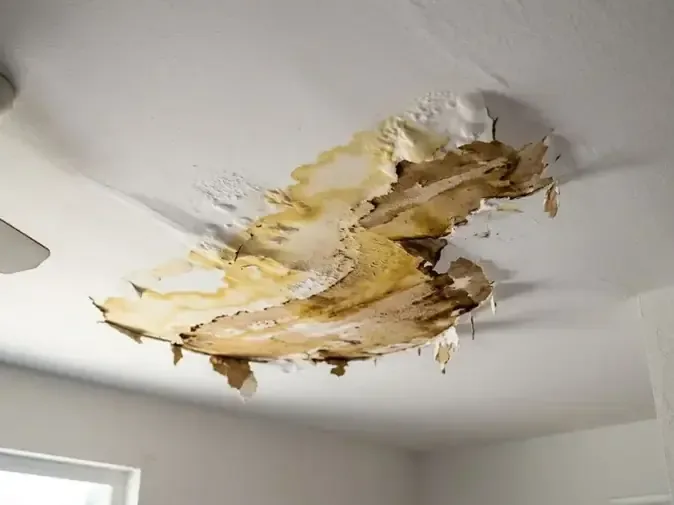
The first sign is usually a stain, a drip or a sagging ceiling. A leak can also show up at a light fixture or a smoke detector, where water finds a gap in the drywall.
Residents who notice any of these signs should treat them as an active leak until a check shows otherwise.
Early signs
A brown ring on a ceiling or a damp spot on a wall means water is already in the cavity above.
- A spreading stain on the ceiling.
- Dripping from a light fixture or vent.
- Paint that bubbles or peels near the ceiling.
Signs of danger
A ceiling that bulges or sags is holding water and can fall without warning. Keep people and pets away from it.
- A bulge in the drywall.
- Water dripping near a light switch or outlet.
- A sudden crack across the ceiling.
First steps for residents
The first steps are the same in the unit with the leak and the unit below. Stop the water if it is safe, protect belongings and tell the property manager.
If water drips near a light fixture, turn off the power for that area at the panel. Do not stand under a bulging ceiling.
If the leak comes from a water heater closet, switch off the heater's power as well as its water supply. A tank that is still heating while empty can be damaged.
- Shut off the water supply to the fixture or appliance if it can be reached.
- Tell the property manager right away, in writing.
- Photograph the damage in both units.
- Move furniture, rugs and electronics away from the wet area.
Working with the property manager
About 31.8% of occupied Goose Creek homes are renter occupied, which is 5,656 of 17,780 occupied units. For those households, the lease and the building rules shape who arranges what.
Residents can ask the manager who will stop the leak, who will start drying and what documents are needed. Clear replies early keep both units from sitting wet.
- Ask who will repair the source of the leak.
- Ask who will arrange extraction and drying.
- Ask what documents the building or the insurer needs.
- Keep every message and receipt.
How both units are dried
A ceiling leak water damage job starts with moisture readings in the unit below, and often in the unit above as well. The crew finds where the water traveled before opening anything.
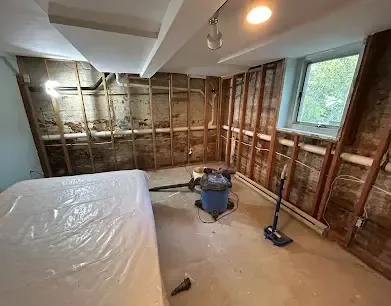
Sagging drywall is cut out, wet insulation is removed and the joist bays are dried. When the source was a washer or a dishwasher, appliance and supply hose leaks also need the floor and cabinet bases checked upstairs.
Fans and dehumidifiers then run under structural drying monitoring until the readings match a dry reference.
Containment keeps dust and moisture from spreading into the rest of the unit, and drying equipment is placed where the readings are highest. Residents are told which rooms are safe to use while the equipment runs.
- Moisture is mapped in both units.
- Wet drywall and insulation are removed.
- Equipment runs in the ceiling cavity and the room.
- Readings are repeated until the framing is dry.
Preventing the next leak
Most upstairs leaks come from parts that wear out. Replacing them on a schedule costs far less than drying two units.
Building managers can help too. A routine walk-through of laundry closets and water heater rooms catches many problems before they reach a ceiling.
- Replace rubber washer hoses with braided hoses.
- Check the dishwasher and ice maker supply for damp spots.
- Test the toilet supply for slow drips.
- Know where the shutoff valves are in the unit.
Questions
Who pays for ceiling damage when the leak comes from upstairs?
That depends on the lease, the building rules and the cause of the leak. Residents can ask the property manager and the insurance company how responsibility is decided. A restoration crew does not decide fault, but it documents what the water reached so that the right party can be asked to pay.
Should a sagging ceiling be poked to drain the water?
Not by a resident. Wet drywall can drop without warning, so keep clear and let a restoration crew open it in a controlled way.
Does the unit above need drying too?
Often yes. Water usually soaks the floor and cabinet bases near the source before it reaches the unit below, so both units are checked. Opening only the upstairs or only the downstairs can leave wet materials behind.
Can a small stain mean a large leak?
Yes. Water collects in the ceiling cavity and insulation before a stain shows, so a small mark can hide a wet area much larger than it looks. Moisture readings, not appearance, show how far the water went.
What if the leak comes from a neighbor's appliance?
The steps are the same: report it to the property manager, photograph the damage and keep records. The source of the water affects who is responsible, not whether drying is needed.
Why are both units photographed?
Photos from each unit show how far the water traveled and when. They help the manager and the insurance company understand the loss.